By Odette Auger, Windspeaker Buffalo Spirit Reporter
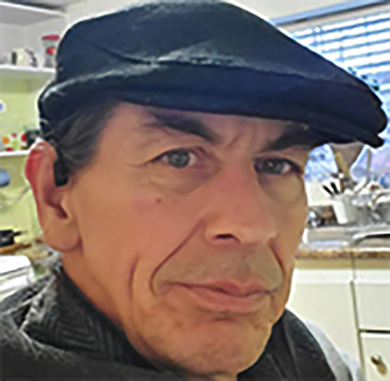
Haida storyteller and cedar weaver Giihlgiigaa, Todd DeVries, is Tsiij Git'anne (Eagle) clan, Old Massett. Along with cedar weaving, he teaches how people can use dreams as a powerful tool, both sleeping dreams and waking dreams.
In a previous story for Windspeaker titled Reincarnation and the interconnectedness of past lives, Giihlgiigaa explained that after death we return to ‘that village back there.’
“That ‘village back there,’ or void, is that space between everything, between the molecules, between atoms, between universes,” he tells Windspeaker.
“That's what scientists are trying to call dark matter or dark energy. Scientists say there's something there, but in our view, there's nothing there,” explained Giihlgiigaa. “But scientists still can't believe it. There's got to be something there, right?”

March was Full Crow Moon
“But recall that the void, the darkness, from darkness comes light,”
he said. “So we [Haida] call that Raven. Raven is everywhere, but
nowhere, yet brought everything into being.”
That void is referred to as the fourth dimension, said Giihlgiigaa.
“When you go into the fourth dimension, there's no need, no relevance to distance anymore. Time is irrelevant because time is a factor of distance and space. That's a formula, so it's not really a dimension in our view,” he explained.
“In most Indigenous views, time is irrelevant in the fourth dimension, and that's where we go when we dream. That's where we go when we die.”
“When we dream and when we die, both can be used to connect with ancestors and receive guidance,” Giihlgiigaa said.
There are four stages of sleeping and they are very similar to the four stages of dying, said Giihlgiigaa.
“First your body goes a little stiff or it gets heavy.” Then “your breathing slows down. It gets harder to breathe through your nose, so you breathe through your mouth.”
“So you got the dissolution of air, the dissolution of fire, dissolution of water, dissolution of earth,” explained Giihlgiigaa. Your body temperature “begins to drop a couple of degrees. And that's why we have a blanket. Then your breathing drops and you're slowing down for the night.” “It's exactly the same stages when you're going—when you're dying. So that's how we dream and how we go through the Spirit World,” he explained.
Reconnecting with Haida dreaming
Giihlgiigaa was one of the Sixties Scoop children, and it wasn’t until he was an adult that he reconnected with his Haida mom, family, and culture.
When he met his mom, he began to dream.
“I started having these wild dreams when I found my mom, all very prophetic. Everything I dreamt about those first two weeks after meeting my mom has been happening for the last 25 years.”
“Everything's aligned right up, just like a prophecy, almost déja vu dreaming,” he said.
While some cultures use psychedelic plant medicines to access visions or guidance, the Haida have other tools, said Giihlgiigaa.
“We don't have any psychedelics up in Haida,” Giihlgiigaa said. “We have mushrooms, but they were never used in ceremony. There's no stories of them being used in ceremony.”
“We have a different way of attaining that dream state,” he said.
“For one, everyone knew it was very common to have dreams, but not everyone dreamt every day because people had to get work done.”
So it was usually the Spirit man that did all the dreaming, Giihlgiigaa said. “You would have visions and he would see things that might happen before they happen and be able to warn the people and make proper decisions to change course.”
Plant medicine, dream aids
Some plant medicines are a cleansing tool, and Giihlgiigaa says one of the most common was Devil's Club, “because it acts like an herbal cleanse. It washes out all the toxins in your body.”
“You do a herbal cleanse once every other month, or four times a year, whatever, twice a year,” he said. Once a body doesn't have all these toxins “inhibiting all your spiritual senses, then you'll have better dreams and you'll be remembering your dreams every night.”
Dreaming is a very powerful tool to guide us, said Giihlgiigaa.
“Every night, even though you may not remember your dreams, you're dreaming and you're planning your next nine months of life. What you're going to do every day.”
“So one night you'd be planning on two weeks. ‘I'll do this next night. Oh, three months down the road, I got to do this’,” he explained. “Before you know it, you're doing those things that you dream about. You have to dream it before you manifest it.”
“Western culture doesn't give dreams a lot of credit,” he said. “It's been pounded out of us.”
There are plant medicines that can be used as dream aids, ”so we can go talk to the Ancestors ‘in the village back there’.”
Giihlgiigaa explained we can ask the Ancestors “if they can guide us through the twists and turns of the pathways to our goals.”
While Devil's Club is the tried and true one, Giihlgiigaa said there is another medicine found all across the country in swamps.
“The swampy, marshy, boggy areas. The name of this plant, ts'áhla, is a word that we use for sinker. The sinker you put on the hook,” said Giihlgiigaa.
“So when you put the bait on the hook, the sinker will take the bait down to the depths of the water where you can't see,” he said.
Ts'áhla is also the word for pillow. “So why would all those three things have the same name? What's the concept here? Haida is a very conceptual language. We try to use one concept to describe many things,” he said.
“That sinker takes the bait to another dimension. We can't see it down there. We know there's fish down there somewhere. And then when your head hits the pillow, your mind goes to another dimension. It dreams, right?”
“So when you make a medicine from that plant, it takes your mind to another dimension so your body can heal,” Giihlgiigaa said.
In English, he says, the plant is called Sweet Gale “and it's a dream key that will help you remember your dreams,” to help impact the length and strength of dreams, so they can be remembered more frequently, he said.
“Dreams are your Spirit talking to you in the dream world, and most people are separated from the Spirit. They call that their inner child because they haven't really given it any attention and haven't really guided it and worked on their spiritual powers. So it's kind of like a child yet not grown up,” he explained.
“Once we start giving it more and more attention, it'll merge with our waking brain and we'll be one again,” said Giihlgiigaa. “It might look like you’re looking back at yourself, but you’re not exiting yourself.”
“Spirit just gets bigger and bigger and bigger,” said Giihlgiigaa. “You are Spirit.”
👉Editor’s Note: It’s important to be well informed about any plant medicine that you choose to use and how it will affect your own body. Do your own research.
Our plant guide Carrie Armstrong shared some plant picking tips in a previous column:
When picking plants for your own use, please pick with care, ensuring you correctly identify the plant prior to use. Take only what you need. Break leaves, flowers, stems off gently as opposed to pulling out by roots.
Please be aware that you pick in a safe, chemical-free area and know that some plants can be toxic at certain times of year. Do not gather any endangered species of plants.
In some Indigenous cultures, tobacco is offered to Mother Earth as a way of showing gratitude for the medicines.
SOURCE: https://windspeaker.com/buffalo-spirit/dream-teachings-connecting-spirit